
The middle of the range,
most of the flagship’s heat.
Metallized nano-ceramic at 87.2% infrared rejection — most of the flagship’s heat performance, at a middle price.
Flagship heat, mid-range price
ZV80 combines a metal layer with ceramic to manage both heat rejection and absorption. It sits about 9 points behind ZV90 on infrared, one step down in price.
Infrared rejection — the heat you actually feel
Total solar energy rejected, the best single number for heat
UV rejection, protecting skin and interior trim
Accelerated weathering test behind the colour warranty
Why the middle tier makes sense
Close to the flagship
87.2% infrared rejection against ZV90’s 96.7%. On most days in most cars, that difference is small — the price difference is not.
Metal and ceramic together
HQ builds ZV80 as a metallized nano-ceramic. The metal layer reflects solar energy while the ceramic absorbs and re-radiates it, which is what holds heat rejection up at lighter shades.
Still a low-reflection finish
Exterior reflectance runs 5.3% to 6.9% — higher than ZV90 but nowhere near an old-style mirror tint.
Every ZV80 shade, measured
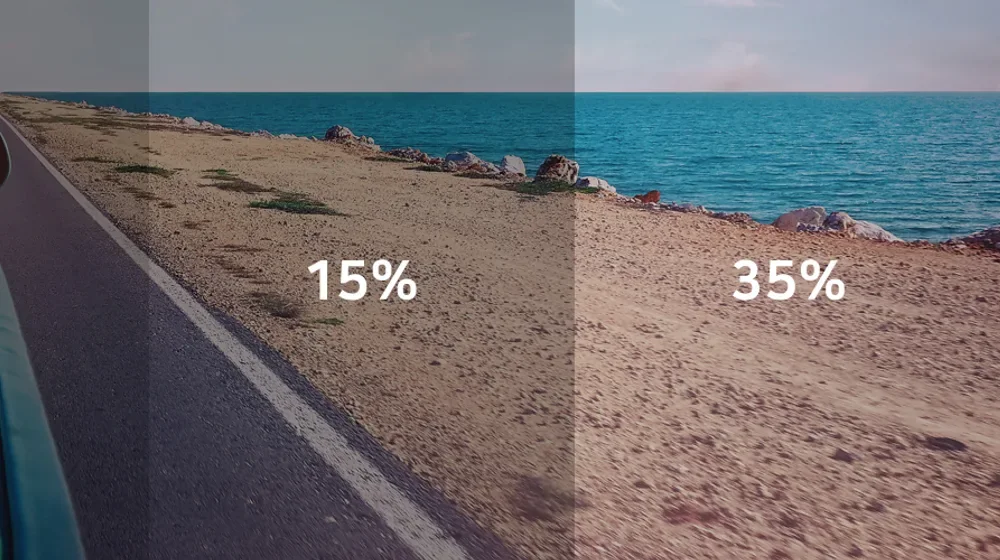
Four shades, from 5.6% for a near-private cabin to 51% for a light finish that still rejects 83.8% of infrared.
| Product | Colour | VLT | IRR | UVR | TSER | VLR int / ext | SC | SHGC |
|---|---|---|---|---|---|---|---|---|
| ZV80-05 | Midnight Black | 5.6% | 87.2% | 99.9% | 61.7% | 5.9% / 5.3% | 0.43 | 0.38 |
| ZV80-15 | Midnight Black | 16.4% | 85.9% | 99.9% | 58.3% | 6.2% / 6.5% | 0.48 | 0.42 |
| ZV80-35 | Midnight Black | 30.5% | 85.6% | 99.9% | 54.2% | 6.1% / 6.9% | 0.53 | 0.46 |
| ZV80-50 | Midnight Black | 51.0% | 83.8% | 99.9% | 47.1% | 6.0% / 5.9% | 0.61 | 0.53 |
Swipe the table sideways to see every column.
VLT visible light transmission — how much light gets through; lower is darker · IRR infrared rejection — the heat you feel · UVR UV rejection — what fades trim and damages skin · TSER total solar energy rejection — all the sun's heat, the best single number · VLR int / ext visible light reflectance, inside face / outside face — high ext looks like a mirror · SC shading coefficient — solar heat let through compared with plain glass; lower is better · SHGC solar heat gain coefficient — the share of solar heat that gets through the glass; lower is better. Which VLT is legal in NZ →
Front side windows must keep 35% total light transmission once the film is on, and your factory glass counts toward that. What the numbers mean and what is legal here →
Every shade in the table comes in this film. See every shade on the car →
How pricing works
Three things set the price of a ZV80 job — and none of them is a number we can guess from here.
Glass count
How many windows are being filmed — two fronts only, or the whole car including the rear screen.
Glass shape
How curved the glass is, and how much preparation it needs before the film goes on.
Film amount
More glass means more film — a van or wagon takes more than a hatch.
Send your plate or a photo and the branch gives you a same-day price, usually without seeing the car. No deposit, and nothing is booked until you say so.
ZV80 questions we get
What do I give up against ZV90?
About 9 points of infrared rejection and 10 points of total solar energy rejection. ZV80 also has a metal layer, where ZV90 has none — if you want a fully metal-free film, go ZV90.
Does the metal layer affect reception?
We have not had reception complaints on ZV80 in New Zealand. If your car is unusually signal-sensitive, or you simply want no metal in the glass at all, ZV90 is the metal-free option.
Which shade should I pick?
ZV80-35 is the usual choice for a car that needs to stay legal on the front sides — but your branch measures the factory glass first, because that counts toward the 35% limit.
How long does the install take?
Two to three hours for a standard sedan. Leave the windows up for two to three days afterwards while the film cures — slight haze or small water pockets during that time are normal and clear on their own.